.png)
388 results found with an empty search
- Total Internal Reflection (TIR) example 01
Solutions: a) Refraction b) 48.6o c) c = 41.8o e) 70o d) Total internal reflection has occured, as the angle of incidence is greater than critical angle and the light is traveling from a denser medium (glass) towards a less dense medium (air) Click on the video tutorial for explanation and working for part (a) and (b). Click on the video tutorial for explanation and working for part (c) to (e).
- Total Internal Reflection (TIR) example 02
Solutions: a) 38.8o b) 41.8o c) 51.2o . The ray does not emerge as total internal reflection has occurred. The angle of incidence is greater than critical angle and the light is traveling from a denser towards a less dense medium. Click here to view the video tutorial for working and explanation for (a) and (b). Click here to view the video tutorial for working and explanation for (c) and (d).
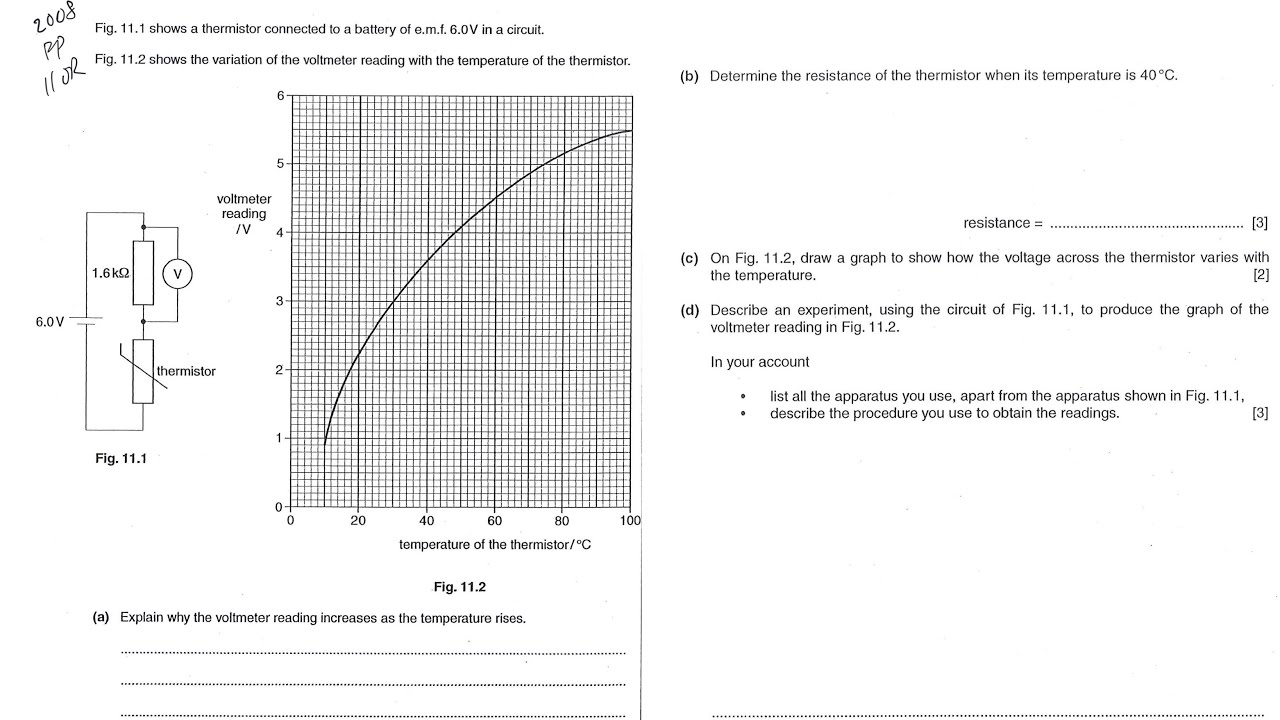
- PP2008Q11OR Thermistor in series with fixed resistor, explanation on pd and graph
As both the fixed resistor and the thermistor are connected in series, the sum of potential difference across them will be equal to the emf of 6.0 V.
- 2013SPp2q9 – Pressure and Moment
Solutions: (a) (i) A bigger force than F can be obtained due to the lever system and hydraulic system . Lever system: Applying principle of moments, the anticlockwise moment by the F is equal to the clockwise moment by the force on piston A (note that the handle is pushing the piston down, but the piston A is pushing on the handle upwards – action = reaction). As the perpendicular distance from F to the pivot is greater than the perpendicular distance of the force by piston to the pivot, the force on the piston A is greater than F at handle. Hydraulic system: As the pressure transmitted in the liquid is the same, pressure at piston A = pressure at piston B. As P = F/A and area of piston A is smaller than area of piston B, a larger force is obtained in piston B. Hence these two systems allow the force on piston B to be greater than F at the handle. (a) (ii) Both liquid and gas molecules are in a continuously random motion. But in liquid, the molecules are closely packed together and able to slide around one another. There is very little empty space between the molecules hence liquid is not compressible. Gas molecules are far apart from one another, hence gas can be easily compressed. (b) P = F/A = 12000 / 0.060 = 200 000 Pa (c) Velocity is the vector quantity while speed is a scalar. As the car goes round the bend, the direction of the car changes. Hence velocity is changing even though speed is constant. Likewise, as the velocity is changing, the car is considered to have an acceleration )and the acceleration is towards the centre of the circle of the bend)
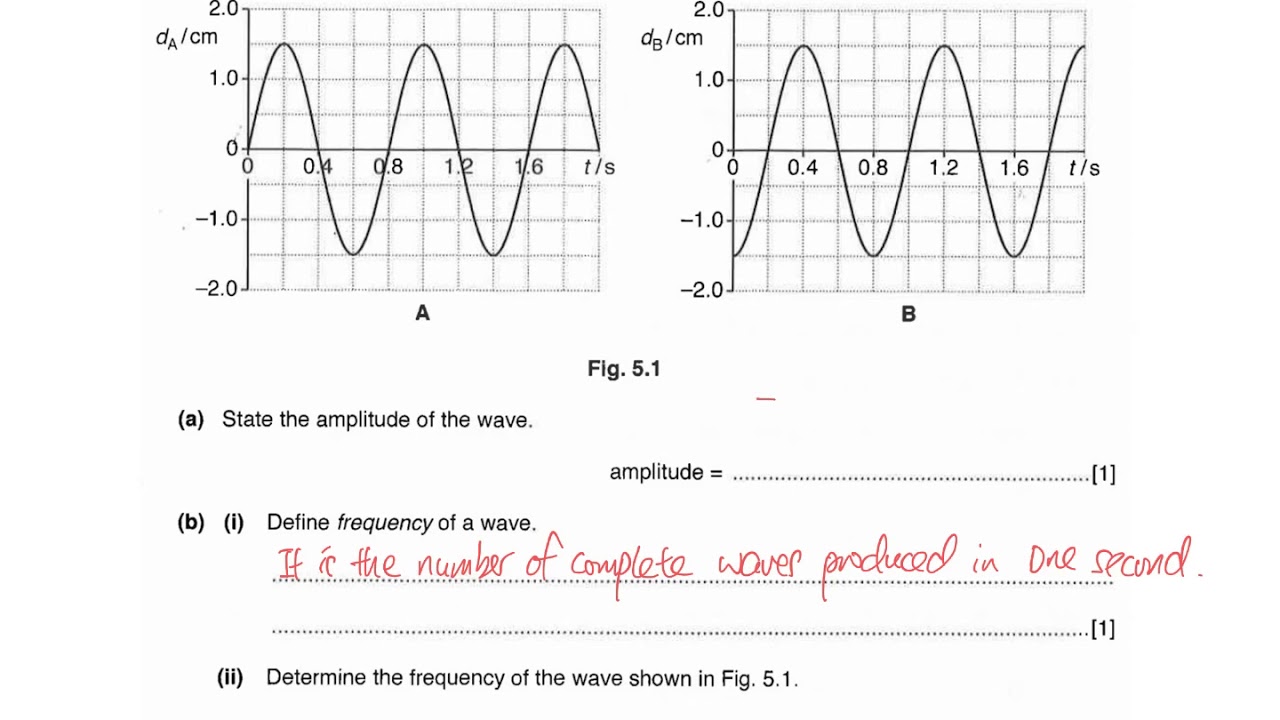
- 2017PurePhyP2Q5 Two points on the rope wave with displacement-time graphs given
In this this question, the displacement-time graphs are given, which are different from displacement-distance graphs. In the displacement-time graphs of A and B, they show the displacement of that particular point at different timing. E,g, at t = 0s, the A is at the rest position (0 displacement) and at time 0.2 s it is at the maximum displacement. This means A is going up from t = 0 s to 0.2 s. Solutions : (a) Amplitude: 1.5 cm (b)(i) Frequency is the number of complete waves produced in 1 second. (ii) period T = 0.8s, f = 1/T = 1/0.8 = 1.25 Hz (c)(i) Closest possible positions of A and B, (refer to the video), is when the time taken for the wave to move from A to B is T/4 = 0.8/4 = 0.2 s. speed = distance/time = 38/0.2 = 190 cm/s approx. 200 cm/s (ii) There are various possibilities in which B can be 38 cm to the right of A. Besides T/4, it can be 1.25T or 2.25 T etc. Hence the speed can be other values. Refer to the video explanation below
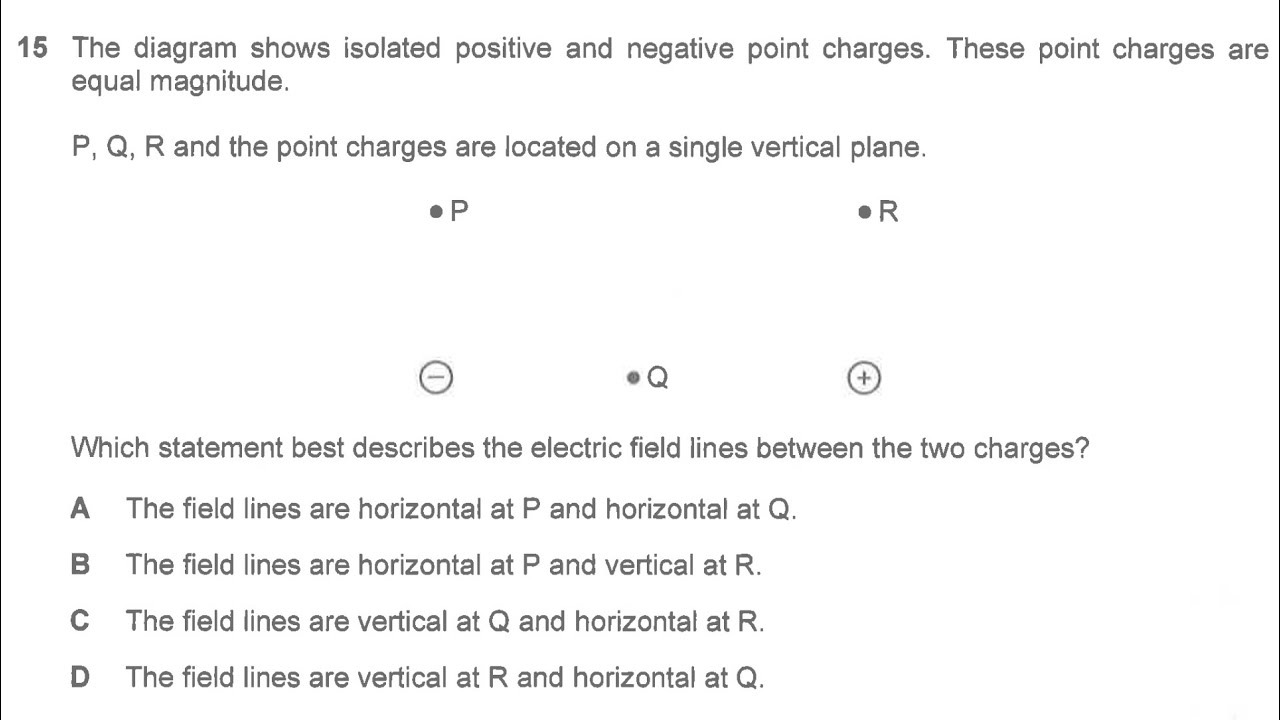
- 2021SPP1Q15 Electric field lines between the two charges
Answer: Option D View the video tutorial for the explanation
- Time interval between two sounds from a gun – direct and reflected sound
Solutions: Option B You can view the video tutorial here or the written solutions below.
- Boy on spring board - Moments Question using Simultaneous Equations
Note: Non-uniform plank means the CG of the plank is not at its centre a) Find the weight of the boy. b) How far is the centre of gravity of the plank from point A? Solutions: a) 300 N and b) 6.67 m Click on the video tutorial if you can’t derive the 2 equations.
- Double-Insulated Appliance – Air purifier in the classroom
Double-insulated appliances are common around us. The air purifiers in our classroom are one good example. In these appliances, only two wires are needed, namely Live and Neutral wires . Earth wire is not required as the casing is made of insulator like plastic for this case. The classic air purifier in our classroom The “double squares” symbol means that this appliance is double-insulated. As you see, the earth wire is not required.